In this Article

When evaluating backend technologies for high-performance systems, the conversation often narrows down to two distinct approaches: the managed runtime environment of Java and the systems-level control of Rust. While Java has held the enterprise crown for decades due to its stability and massive ecosystem, Rust has matured into a viable alternative for scenarios where latency and resource efficiency are critical.
This post analyzes the architectural differences that drive performance in both languages, specifically focusing on compilation models, memory management, and runtime behavior.
The Compilation Model: JIT vs AOT
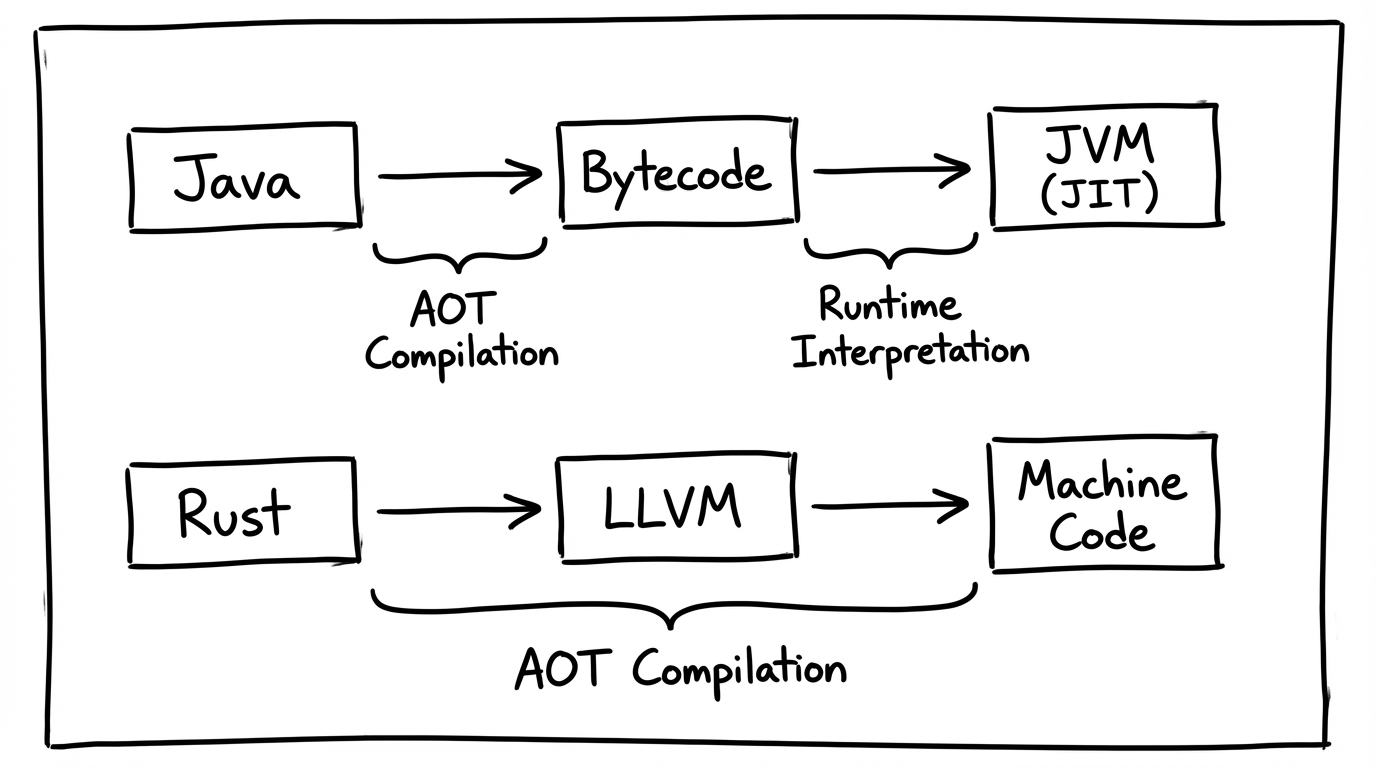
The fundamental difference in how code is executed defines the performance characteristics of these two languages. Java relies on the Java Virtual Machine (JVM), whereas Rust compiles directly to machine code.
Java: Just-In-Time (JIT) Compilation
Java source code compiles into bytecode (.class files), which is platform-independent. When you run a Java application, the JVM interprets this bytecode. Over time, the JIT compiler identifies "hot spots" (frequently executed code paths) and compiles them into native machine code during execution.
- Pros: The JVM can perform runtime optimizations based on actual usage patterns (profile-guided optimization).
- Cons: There is a "warm-up" period. The application starts slower and consumes CPU cycles for compilation while the application is running.
Rust: Ahead-Of-Time (AOT) Compilation
Rust uses LLVM to compile source code directly into machine code for a specific architecture before execution.
- Pros: Instant startup and consistent performance from the first millisecond. No runtime overhead for compilation.
- Cons: Longer build times for the developer.
Memory Management: The Garbage Collector vs Ownership
Memory management is the single biggest factor differentiating the performance profiles of Rust and Java.
Java: Garbage Collection (GC)
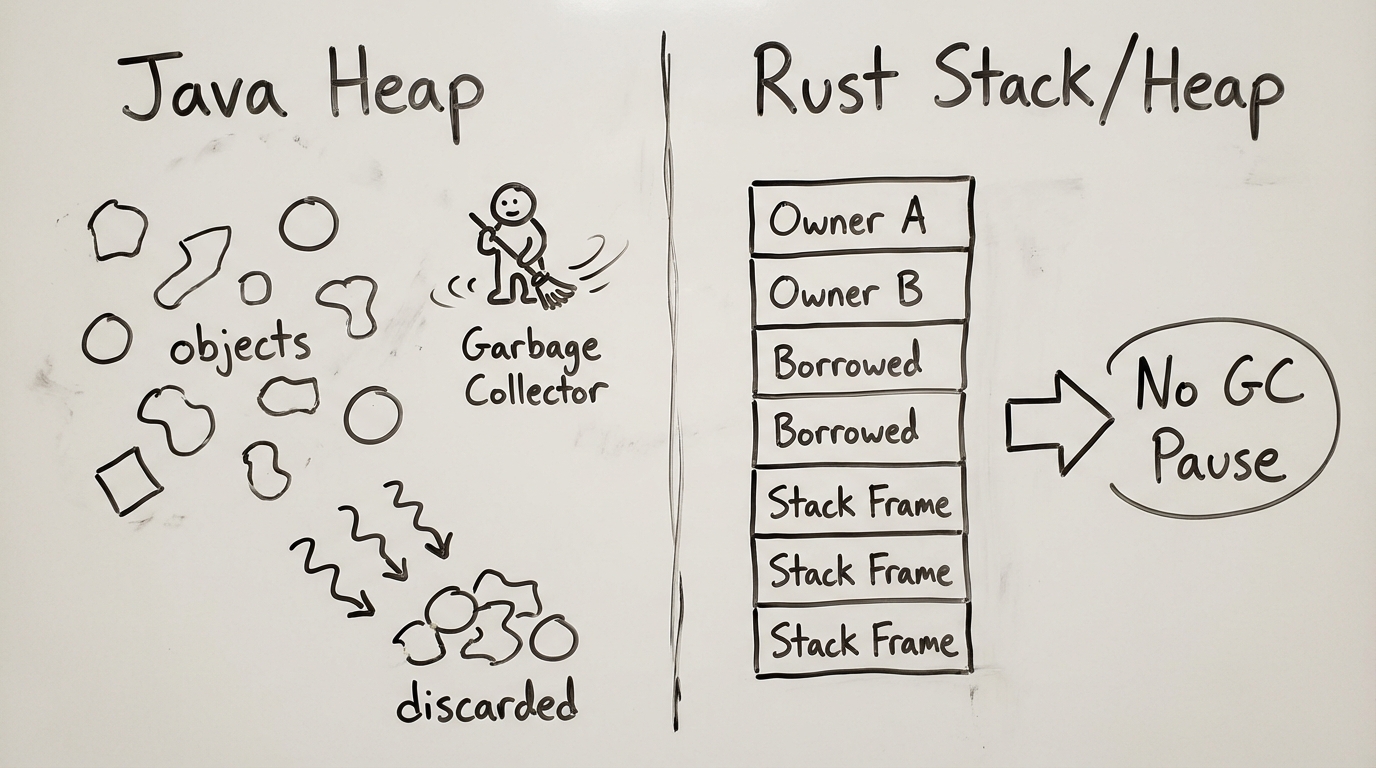
Java developers allocate objects on the heap, and the Garbage Collector runs in the background to reclaim memory that is no longer in use. While modern GCs (like ZGC or Shenandoah) are incredibly efficient, they still introduce non-determinism.
- Latency Spikes: Occasional "stop-the-world" pauses can occur when the GC needs to clean up, causing inconsistent response times.
- Throughput: The CPU spends a portion of its time managing memory rather than executing business logic.
Rust: Ownership and Borrowing
Rust has no Garbage Collector. Instead, it uses a compile-time ownership model. The compiler tracks exactly when memory is allocated and when it should be freed. If the code violates memory safety rules, it fails to compile.
- Predictability: There are no GC pauses. Memory is freed immediately when a variable goes out of scope.
- Efficiency: This results in "zero-cost abstractions," where high-level coding concepts do not incur runtime performance penalties.
Code Comparison: Resource Management
Here is how the two languages handle a scenario where a large resource (like a buffer or file handler) needs to be managed.
Java Implementation
In Java, we rely on the GC to eventually clean up the object, or we use try-with-resources to be explicit. However, the allocation itself happens on the heap, adding pressure to the GC.
import java.io.BufferedReader;
import java.io.FileReader;
import java.io.IOException;

public class ResourceLoader {
    public static void main(String[] args) {
        // Java handles memory allocation on the Heap
        // The JVM decides when to reclaim this memory if not explicitly closed
        try {
            loadFile("large_data.txt");
        } catch (IOException e) {
            e.printStackTrace();
        }
    }

    public static void loadFile(String path) throws IOException {
        // Try-with-resources ensures the file is closed,
        // but the object memory management is still up to the JVM
        try (BufferedReader br = new BufferedReader(new FileReader(path))) {
            String line;
            while ((line = br.readLine()) != null) {
                // Simulate processing
                processLine(line);
            }
        }
    }

    private static void processLine(String line) {
        // Simulation of work
    }
}
Rust Implementation
Rust enforces cleanup at the end of the scope }. This is deterministic.
use std::fs::File;
use std::io::{self, BufRead};
use std::path::Path;

fn main() {
    // Rust handles memory via RAII (Resource Acquisition Is Initialization)
    // When 'lines' goes out of scope, memory is freed immediately.
    if let Ok(lines) = read_lines("large_data.txt") {
        for line in lines {
            if let Ok(ip) = line {
                process_line(&ip);
            }
        }
    }
    // Memory is freed here. No GC scan required.
}

fn read_lines<P>(filename: P) -> io::Result<io::Lines<io::BufReader<File>>>
where P: AsRef<Path>, {
    let file = File::open(filename)?;
    Ok(io::BufReader::new(file).lines())
}

fn process_line(_line: &str) {
    // Simulation of work
}
Execution Speed and Compute
When running raw computational tasks, Rust typically outperforms Java. Because Rust allows manual layout of data in memory, developers can optimize for CPU cache locality, avoiding the pointer chasing often seen in Java's object graphs.
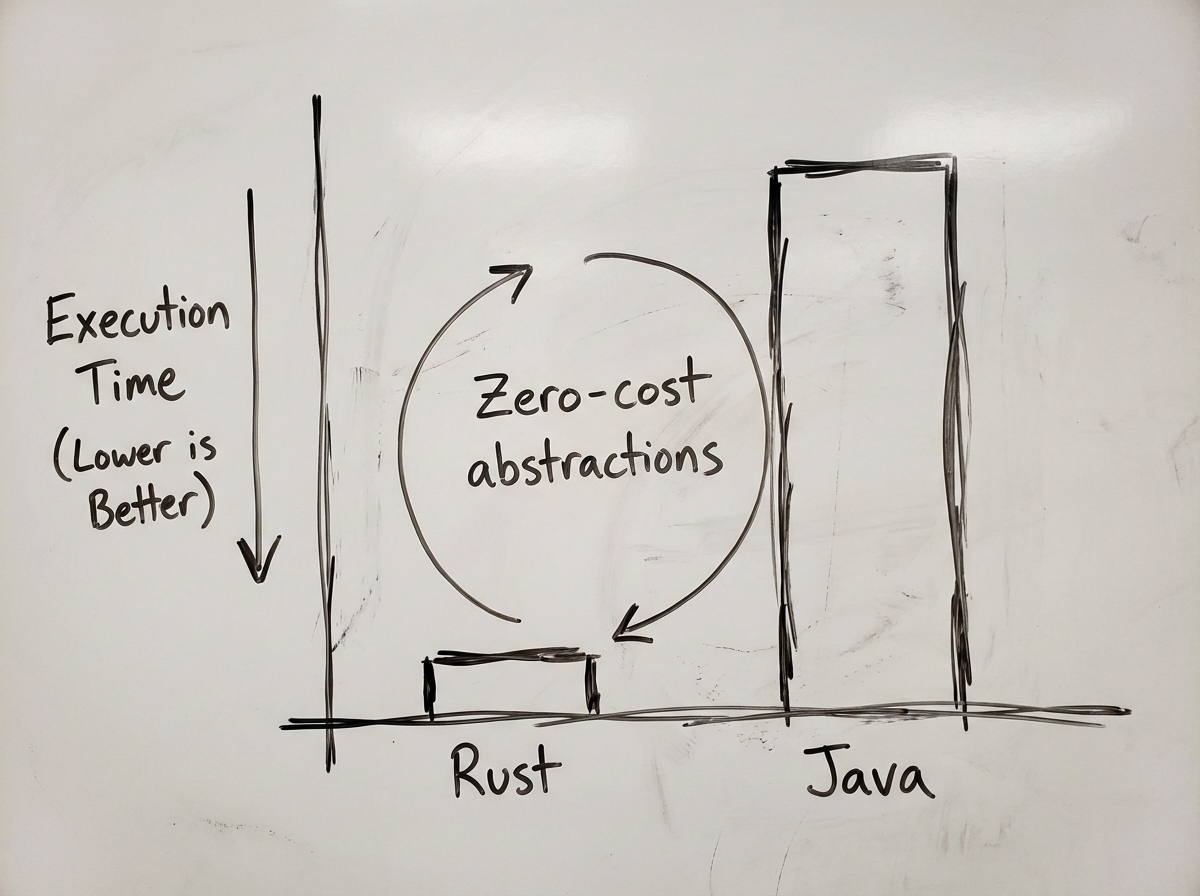
The diagram above illustrates the execution gap. While JIT compilers are impressive, they cannot always compete with the aggressive optimizations an AOT compiler can perform when it has full visibility of the code and memory layout without the safety net of a virtual machine.
Memory Footprint and Stability
For microservices and containerized environments (like Kubernetes), memory footprint translates directly to infrastructure costs.
Java's Overhead
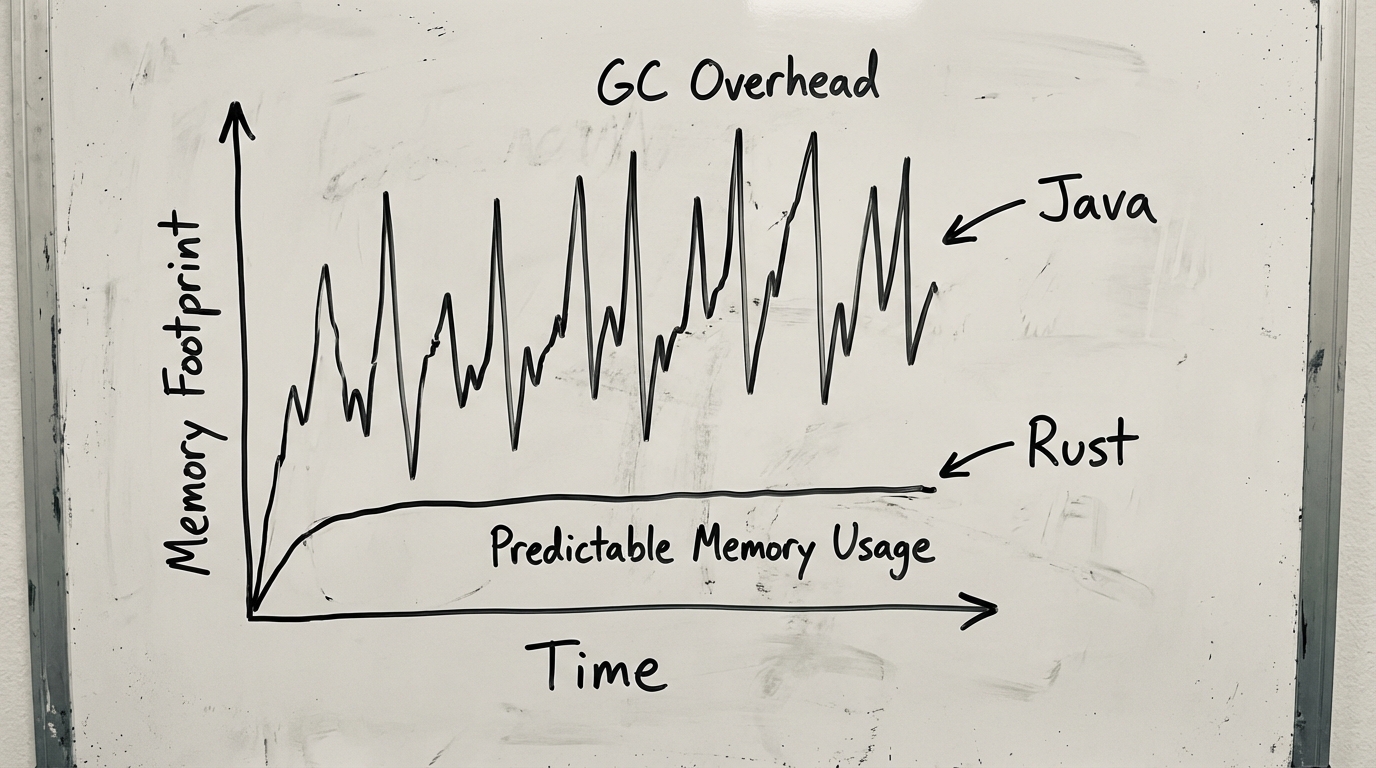
A simple "Hello World" Java application requires the JVM to load, which can consume tens of megabytes of RAM before the application code even runs. Furthermore, to run efficiently, the JVM often requests more memory than it strictly needs to reduce the frequency of Garbage Collection cycles.
Rust's Efficiency
Rust binaries are self-contained and small. A comparable Rust microservice might run with a few megabytes of RAM. The memory usage graph (as shown in the image above) is flat and predictable because there are no allocation spikes associated with GC cycles.
Code Example: CPU Intensive Task
To visualize the performance difference in a compute-heavy scenario, consider a simple loop calculating a mathematical sequence.
Java
In Java, Integer objects (wrappers) can cause overhead compared to primitive int. While the JIT handles this well, unboxing still poses a risk in complex structures.
public class ComputeTask {
    public static void main(String[] args) {
        long start = System.nanoTime();

        long sum = 0;
        // 100 million iterations
        for (int i = 0; i < 100_000_000; i++) {
            sum += compute(i);
        }

        long duration = (System.nanoTime() - start) / 1_000_000;
        System.out.println("Result: " + sum + " Time: " + duration + "ms");
    }

    // JIT should inline this, but overhead exists initially
    private static long compute(int input) {
        return (input * 2) + (input / 3);
    }
}
Rust Rust optimizes this loop aggressively. It may even unroll the loop or use SIMD (Single Instruction, Multiple Data) instructions automatically if the CPU supports it.
use std::time::Instant;

fn main() {
    let start = Instant::now();

    let mut sum: i64 = 0;
    // 100 million iterations
    // Rust iterators compile down to efficient loops
    for i in 0..100_000_000 {
        sum += compute(i);
    }

    let duration = start.elapsed();
    println!("Result: {} Time: {:?}", sum, duration);
}

// Inline hint tells the compiler to replace the function call with the body
#[inline]
fn compute(input: i64) -> i64 {
    (input * 2) + (input / 3)
}
Conclusion
The choice between Rust and Java is rarely about raw speed alone. It is about the specific requirements of your system.
- Choose Java if you need a vast ecosystem of libraries, faster initial development speed, and if your team is already proficient in it. The performance penalty is often negligible for standard business applications (CRUD apps).
- Choose Rust if you are building systems where predictable latency, low memory footprint, and high CPU efficiency are non-negotiable. This includes command-line tools, embedded devices, and high-throughput network services.
Rust requires more effort upfront to satisfy the compiler's strict memory rules, but that investment pays dividends in runtime stability and efficiency. Java allows for looser initial coding but taxes the system resources at runtime to maintain that flexibility.